Independent Sponsor Series: “We’re Underwriting a Person” – Max DeZara of Akoya Capital Shares the Winning Formula of Their Sector Leader Model
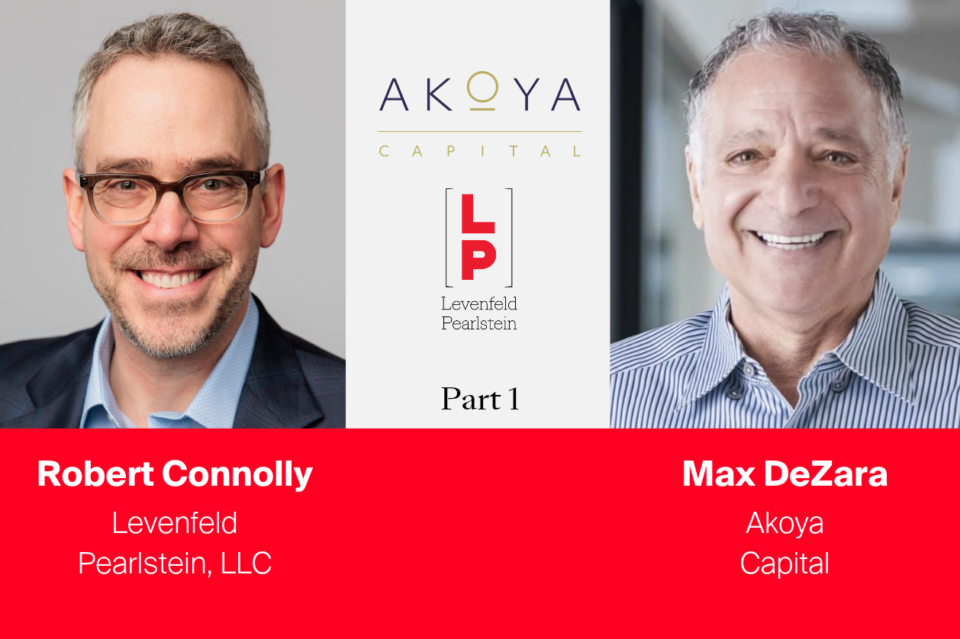
Robert Connolly, a partner in LP’s Corporate Practice Group and leader of LP’s Independent Sponsor team, is sharing a series of conversations with independent sponsors, capital providers, and other professionals. The goal is to help businesses, investors, and deal professionals better understand the changing independent sponsor landscape.
Below is his conversation with Max DeZara, the founder and managing partner of Akoya Capital, one of the leading independent sponsors in the United States. Max has decades of experience identifying and executing successful investment opportunities across diverse industries, with expertise working with founders and CEOs of family-owned businesses to create value for shareholders.
In this first of a three-part series, Max discusses Akoya’s sector leader model, including the firm’s people-first investment approach and how his background as the founder of an executive search firm led to the founding of Akoya over 20 years ago. In part two, he shares his views on the evolution of the independent sponsor market, and in part three, he offers advice for business owners considering a sale.
Responses have been edited for brevity and clarity.
Can you tell us about Akoya Capital’s sector leader model?
The sector leader model is the cornerstone of our investment thesis. At Akoya, we have a sector-focused, leader-led strategy. We invest in three primary areas, each led by an industry icon. Our partners have spent decades in operating roles. They are seasoned, highly accomplished operating executives who serve as our river guide. Everything we do is thematic and centered around leveraging our sector leaders’ decades of domain expertise. Our sector leaders are deeply involved in developing a detailed investment thesis, and we spend a lot of time vetting that investment thesis before going to market.
A key distinction between our model and other firms’ approaches is the role of the sector leaders and how we bring them in. Many private equity firms talk about working with operating partners, but they are used as a website resume or for help solving a specific problem. Our process is quite different. We spend a lot of time vetting our sector leaders up front, and when we bring one on board, they become full equity partners at Akoya. It’s an exclusive relationship, and we make a significant mutual commitment to support the sector leader in executing a buy-and-build strategy in their area of expertise.
Sector leaders are involved in the entire process from start to finish, beginning with building the investment thesis. Once we align on the investment thesis, we proactively generate deals that closely align with that strategy. Our sector leaders are very involved pre-close, including stress-testing the market thesis, helping us source and screen targets, and establishing platform credibility when we approach owners. When we approach owners, we have a peer-to-peer conversation with the business owner, not a finance professional-to-business owner discussion. We can speak their language and build tremendous credibility, gravitas, and a meaningful connection with the owners of the businesses we’re considering investing in.
Once we have an LOI with a target acquisition candidate, our sector leaders work closely with that business’s founder and the Akoya team to jointly develop our value creation plan, which is essentially the roadmap for how we’ll unlock value during our hold period. We need collaboration, alignment, and buy-in from the business owners on how we will do that, so the process isn’t about Akoya developing a plan and imposing it on management to execute.
After closing, our sector leaders serve as the board’s executive chair. For Akoya, it is a very active board role. Depending on the company’s needs, our sector leaders typically spend two to three days a month at the portfolio company level, mentoring the CEO, evaluating add-on opportunities, and assisting with the selection process as we build the team.
Our sector leaders take a very hands-on approach. While they’re not operating the company, they have advanced in their careers from franchise player to coach in their industry, so to speak. They mentor, coach, and give back. If the train gets off the tracks and the business isn’t performing, our sector leaders can step in on an interim basis if needed, providing a safety net through our deep operating experience.
Throughout the hold period, our sector leaders own the buy-and-build roadmap. Sourcing, negotiating, and integrating add-ons are important parts of their role. We work hard to keep them engaged during the search process. We have a very structured cadence, including regular joint pipeline reviews and ad hoc reviews as interesting targets surface.
Our sector leaders’ compensation is weighted heavily towards equity in the platform rather than a large cash salary during the buildup. This ensures they’re underwriting the same outcome that we are and keeps our cash burn rate modest during the search process.
We involve sector leaders very early in the market mapping phase. We are very clear about the attributes we’re searching for in a platform acquisition candidate, which reflects our operating judgment, not just their financial thesis. Our sector leaders’ names and reputations enter the market, so they show good judgment and discernment in pursuing appropriate opportunities.
We have dozens of structured conversations with the target’s customers, competitors, and suppliers before we commit capital. This isn’t just a handful of references; it’s a 360-degree review, and our sector leaders are integral to guiding and leading those discussions.
The bottom line is, we’re underwriting a person – our sector leader – as much as we are a business plan. Market mapping ensures the person and the plan align with what the market’s telling us. For better or for worse, every platform we build starts with finding the right sector leader before we find the first target. To us, the operator matters more than the initial acquisition.
What is your process for finding the sector leader? How do you initiate that process?
Our approach has always been people first, not industry first. We underwrite the person first. We ask them to put together a very detailed investment thesis around the industry that they’re coming out of. We want to know why this is an industry we should invest in, how we’ll find a risk-adjusted return in this specific industry, and what business attributes we’re looking for. They put together a very detailed investment thesis that we vet and validate. So, the first stage gate question is: do we have the right person?
The second stage gate is: do we have an investment thesis we’re convicted about, and do we believe we can execute it and generate a risk-adjusted return on invested capital? Once we get through that stage gate, we turn our attention to deal generation. At this stage, we look for businesses that are in our strike zone, so to speak.
This doesn’t mean we couldn’t proceed in another way. We could pick an industry,
do the investment thesis, and then find an operating executive. But to this point, it’s been people first and invest in the sector second.
Can you tell us about your background in human capital and what led to you founding Akoya Capital?
I founded the Carlyle Group, a national boutique executive search firm, in 1982 and ran it for two decades before selling it to the Whitney Group. As a result of that merger, we created a top 10 global executive search firm with extensive international reach. Shortly after the acquisition, I was elected vice chair of the board, leading the firm’s global private equity practice for roughly a decade. In this role, I placed board members and C-suite operators into PE-backed companies. Sitting across from dozens of PE firms as they hired taught me about which firms treated people decisions as a discipline, revisiting them consistently to assess board composition, CEO fit, and functional gaps, versus the firms that hired once, closed the book, and hoped. The former consistently created more value.
I was also drawn to the handful of private equity firms that took an operating-eccentric approach towards unlocking value with their portfolio company, whereby they would align with industry luminaries, people with decades of relevant industry experience, and then pair those industry rock stars with a highly skilled team of investment professionals. That approach intuitively made a lot of sense because it is about investing in businesses that you truly understand and bringing significant intellectual capital to support your financial capital.
As I started to bifurcate the market, it became clear that only a handful of firms were executing that strategy successfully. Most private equity firms, particularly in the middle market and lower end of the middle market, were comprised of uber-smart finance professionals who tended to hire other uber-smart finance professionals without operating experience. These professionals might not have had experience worrying about making payroll, developing and executing a strategy, or dealing with the people issues entrepreneurs face, yet they were empowered to make these investment decisions and guide strategy at the operating company level, which puzzled me. What I saw working effectively was the sector-focused strategy, which intuitively made a lot of sense to me. However, the firms executing that strategy were typically mega funds with billions and billions of AUM. But in the middle market – and specifically the lower end of the middle market – that strategy was virtually non-existent.
This gap gave rise to Akoya. I had a front-row seat to what was working well – which was a people-led, sector-focused strategy – and I saw an opportunity to bring that approach to the lower end of the middle market. We’ve developed a rigorous, largely unemotional assessment methodology, carried over from our search business experience, to benchmark candidates against the specific demands of a founder-owned lower middle market company, instead of a generic executive bar. For 20 years, I was paid to assess executive talent before I ever wrote a check, so I use that same muscle differently now with what we’re doing here at Akoya.
From a human capital perspective, especially with family-owned businesses on the lower end of the middle market, we often see opportunities to augment the leadership team. We’re always thinking with the end in mind. We’re very growth-oriented investors. When we evaluate an investment opportunity, we need conviction that, during our hold period, we can double, triple, or quadruple the company’s size. If my experience has taught me anything, it’s that this is about putting the right people in the right seats, so we tend to over-invest in people early in our hold period. We want to make sure we have the proper organizational structure in place to support scaling the company and taking it to the next level.
In nearly every deal, the CFO function gets a rigorous look early on, because the financial infrastructure is usually the biggest single gap in a founder-owned business. We raise this with founders as a value-creation opportunity, not a vote of no confidence.
With the CEO succession plan, roughly a third of deals keep the founder as CEO during the transition period, a third promote from within (assuming there’s a logical successor), and a third bring someone in from the outside. For us, the read starts forming during diligence, from how the founder talks about delegating and their management team’s bench strength. That’s the compass we use to determine how to build out the organization from a human capital perspective.
More often, there will be an environmental mismatch than a competence gap. For instance, putting someone who’s excellent at scaling a large team and budget and needs those resources to function into a leaner, more hands-on, founder-run setting can be an issue. So, we pay close attention to the cultural aspects because we’re investing in family-run, founder-owned businesses, and our objective during our hold period is to transition them to a professionally managed business. There are many nuances when we focus on culture to preserve the best parts of that culture while also creating a high-performing environment.
The single biggest lever we pull in every deal is not the financial structure; it’s the human capital component.
You can read more about Akoya Capital and its model in this in-depth interview with managing directors Pat Riley and Lukasz Wrona.
For more information on Max DeZara, visit his bio. For more information on Akoya Capital, visit their website.
To read other articles in this series, please see here: Insights | LP (lplegal.com)
Interested in participating in a future interview series? Please contact Robert Connolly.