Independent Sponsor Series: Nicolò Vergani of V&A Capital Discusses Investment Strategy and the Middle Market M&A Outlook
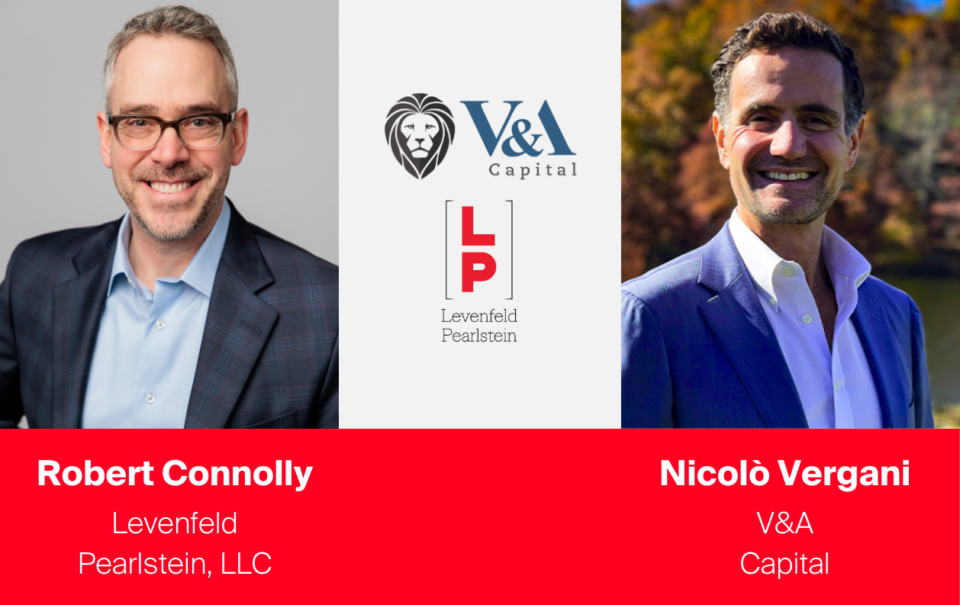
To help businesses, investors, and deal professionals better understand the evolving independent sponsor landscape, Robert Connolly – a partner in LP’s Corporate Practice Group and leader of LP’s Independent Sponsor team – shares a series of conversations with independent sponsors, capital providers, and other professionals.
Below is his conversation with Nicolò Vergani, managing partner at V&A Capital, a New York-based investment firm focused on investing in lower middle market companies primarily in the manufacturing and distribution spaces. Before founding V&A Capital, he was a principal at Lincolnshire Management, a $1.7 billion private equity firm. Among other topics, in this interview, Nicolò shares V&A Capital’s investment strategy and differentiators, discusses their ideal equity investment partner, and offers advice to business owners looking to sell their company.
The responses below have been edited slightly for brevity and clarity.
Can you provide an overview of V&A Capital?
We launched V&A Capital at the end of 2013. I had worked for a funded group – Lincolnshire Management, a New York based private equity fund, for 10 years, doing deals in the U.S. middle market. We owned companies such as Riddell (NFL helmet manufacturer) and Prince (tennis racket manufacturer), computer repair businesses, and tractor-trailer manufacturers, among others. I cut my teeth at Lincolnshire for 10 years doing deals in the middle market (i.e. companies with $10-30 million of EBITDA), and then decided to capitalize on the network I had established with lenders, brokers, lawyers, and CEOs/executives by trying my luck in what was then not as popular as now: the world of independent sponsors. There were only a few of us back then, which I liked because you could find leading niche businesses for reasonable valuations in the lower middle market, which we define as companies with $15-50 million of revenue and $2-8 million of EBITDA.
My initial idea was to bring my experience working with much larger companies – originating, structuring, refinancing, selling and working with management teams to execute growth strategies – to the lower middle market, which is where I saw an opportunity. In the middle market, if a company does $100 million in sales and has $20 million in EBITDA, it’s not as easy to squeeze much value out of that company. Lenders are more standardized, especially cash flow lenders, which have little wiggle room from the typical 40% equity and 60% debt split. You can’t do deals with 95% debt, like funds used to do in the 1990s, so you need to be patient and be more creative in identifying and executing on operational strategies to create value for the equity investors. The space where I thought I could add – and extract – the most value was the lower middle market, so I founded V&A Capital at the end of 2013.
Although my background is as a generalist, at V&A Capital, we focus primarily on U.S. manufacturing and distribution businesses. We have completed six acquisitions, including a few platform add-ons for existing portfolio companies. We have realized three of the six investments, and we have three remaining companies. When I started V&A Capital, I needed an analyst and Nirav Amin, one of our partners, was willing to take a leap of faith and joined me in my new adventure. Nirav is now a very effective partner, as capable and experienced as anybody in the industry. About a year later, in January 2015, we closed our first investment when we acquired Precision Kidd Steel Company, a steel processing business based in Pittsburgh.
What differentiates V&A Capital from other independent sponsors?
One of the things that differentiates us from the competition is our team’s experience. In addition to Nirav, who has extensive operating experience from managing his own businesses, the team consists of Chuck Mills and Jim Binch, both former Lincolnshire managing directors. We also have another operating partner, who is a former CEO of one of our portfolio companies. We all have significant experience in either managing companies or working in private equity with billion-dollar funds. We apply that experience and background to the lower middle market.
Another differentiator is the team’s diversity. Jim is an operating partner who’s been CEO of numerous companies, from publicly traded companies to small private enterprises. Chuck, who was my mentor at Lincolnshire, has 20+ years of experience in financial services and private equity. Nirav has extensive experience managing family businesses and started his career as a CPA at a global accounting firm. And I have a background as a lawyer, working at Davis Polk and other law firms before jumping into private equity and, being born and raised in Italy before coming to the US in the late 90s to get a master’s degree at Berkeley, CA, have a European background. We have a diverse set of backgrounds that you don’t find in at many independent sponsors, but which is valued by management teams and owners.
The third differentiator is that we have a lot of skin in the game. Unlike some other independent sponsors, we invest our own money in each of our investments. We consider ourselves more as a family office than an independent sponsor because, in every deal, we invest 50% or more of the equity. We write substantial checks, which might be the reason we are committed to close a deal when we executed an LOI. We’re not randomly fishing for companies, trying to lock them up for months while we search for equity backing, as is typical with many independent sponsors. Often times, these deals never get to closing. This is an important additional differentiating factor for V&A – as a family office, we have the capital in place and available to ensure a greater certainty of close. In fact, in the United States, we have a perfect record to date. We signed six LOIs, and we closed six deals. I don’t know how many other independent sponsors or private equity funds that have track record. We’re an independent sponsor in certain respects, but really think of ourselves a family office because it’s our money on the line.
What is V&A Capital’s investment criteria and target deal size?
We focus on the lower middle market because that’s where we see opportunity. The vast majority of the companies that we have invested in have been family-owned for more than a generation. We like to invest in companies with a long track record and, regardless of size, we look for those with a distinctive niche in which they are the dominant player. In the United States, one can still find small businesses with only $20 million in revenue but with significant, if not dominant, market share in their respective industries.
Over the years, we’ve demonstrated that we respect and preserve the culture of the companies that we acquire. It’s important to note that we are not turnaround investors nor do we look to implement major restructurings in our investments if it’s not needed. Our goal is to leverage resources and knowhow more commonly available to larger middle market businesses to assist our management teams in the execution of their identified growth plans. We’re looking for partnerships with former owners, managers, or executives who have a plan in mind but not the resources or knowhow to execute it. We target solid, long-standing platforms with a defensible niche, where we can add value to the business by either growing organically or through add on acquisitions.
Typically, for add on acquisitions, we look for complementary businesses that serve different geographic areas, offer related or adjacent products, or serve certain customers for whom there’s an opportunity to cross-sell. For instance, we owned a company that was a distributor of tubes and pipes and sourced its inventory globally directly from the mills, which is unusual for a company of that size. The margins were very good for that reason. A couple of years later, when we added another business distributing fittings and flanges, it was a near perfect fit. The platform company, Federal Steel Supply, is based in St. Louis, MO and operated mainly in St. Louis, Missouri, Houston, Texas, and some other regions. The add-on company was based in Lafayette, LA and operated in New Mexico, West Texas and a few other areas. We saw opportunities for geographical integration, product integration, and cross-selling through the one-stop shop approach. Additionally, because the add-on company had been buying its inventory and products from other distributors, we saw an opportunity to increase its margins by sourcing through the platform company and buying direct from mills.
That is a typical example of what we try to do with these businesses. We bought the platform business, Federal Steel Supply, when it was doing about $25 million in sales and had $2.5 million in EBITDA. Then we acquired the add-on company, Process Piping Materials, a couple of years later, basically for working capital. We sold the combined entity a year and a half later, when the combined entity was doing about $80 million in sales and $11 million of EBITDA. That was a massive home run for everybody, and it encapsulated our philosophy for adding value to our businesses.
Since V&A Capital is bringing 50% equity, how do you typically evaluate potential capital partners?
Typically, we rank potential capital partners in terms of priority. The most valued equity partner we want to get involved is a former owner. We like when the owners from whom we acquire a business show that they believe in the company and growth strategy. We also implement a transition period with the former owners following closing if there is any need for a change in leadership. I don’t recall an instance in which we had to replace the management team on day one. We need the former owners’ help, and we typically like to have them involved because they know the business better than anyone else. Regardless of how much we think we know about the business, their knowledge is infinitely more valuable and complete than ours. So, we try to be humble and take a modest approach with former owners as our co-investors. Depending on how the target company is growing or the prospects in the business plan or budget, such co-investment could be in the form of a note, but equity is one of the things that we look for from owner-founders when we partner with them.
Then, because we invest a lot of equity ourselves, we generally don’t have many institutional investors. We fill the gaps by going to our network of wealthy individuals who can co-invest with us. These investors are usually friends and family because of the way we structure the deal. In order to manage risk, we generally apply a more sophisticated and flexible structure to our deals in the lower middle market, including cash and non-cash components. For a $30 million deal, we might include equity reinvest, notes and multi-year earnouts to help bridge the gap between our assessed value and that perceived by the sellers, providing them with the opportunity to achieve additional upside as well as allowing us to ameliorate any potential downside risks. We’ve successfully translated such structures, which we commonly applied to larger middle market deals during our time at Lincolnshire, to the lower middle market. As a result, our equity contribution is generally lower, especially in an asset-based deal. In these transactions, lenders are more lenient than cash flow lenders and are often willing to lend a larger percentage of the capital structure to the extent there are sufficient assets and cash flow to cover their loans.
Among V&A’s pool of co-investors, some have institutional experience as private equity leaders or M&A lawyers that want to diversify their investments. We also have wealthy entrepreneurs, former private equity CEOs, and portfolio company executives who are co-investors with us. We are a hybrid because we have sophisticated investors with “institutional” experience who are not pension funds or private equity funds.
So far, we have been able to complete our transactions without partnering with institutional equity investors. For larger deals, if we believe that they are interesting but beyond our “bite size”, we will often share these with friendly institutional investors with whom we have developed strong relationships. For certain deal sizes, sourcing proprietary transactions is more challenging. We put a lot of skin in the game ourselves, and after our home run when we exited Fed Steel in 2023, individuals and private investors have been knocking at our door. I always tell them not to expect a 25x return, because it likely won’t happen. I tell them that if we return three times, they should be pleased. If we return four, it’s an outstanding investment. If we return five times, it’s exceptional. I don’t exclude institutional investors; we haven’t needed them so far but we’d be happy to entertain including them in our pool of co-investors if it makes sense in the future.
How do you approach an exit strategy?
One of the benefits of being an independent sponsor is that we don’t have a strict timeline. We typically sit down with sellers and develop a plan together. If the plan takes three years, we’ll stay three years. If the plan takes seven years, then we’re patient because we can be patient. Our investors don’t necessarily have any time constraints. Of course, the longer we hold the investment, the lower the IRR is, but our investors generally value return on invested capital as much if not more than IRR and percentages. They’re patient and understand that we’ve had some investments for three years and others for nine. Again, the advantage of our investment strategy is that we can be patient. We’re more like a family office than private equity in that way.
Initially, we develop a strategy with the management team. We identify where a portfolio company can grow, such as adjacent geographic markets or product offerings they don’t cover or where they are not as strong, and then we implement that plan. We share our expertise – operational, financial, structural, or acquisition origination – and then once we implement the plan, we adjust and adapt if needed. It’s typically three to five years for us to execute on growth strategies, but it could be two or ten. Sometimes, it’s a process of trial and adjustment to achieve the growth that we target.
When we have successfully implemented a growth path, the company is in good shape, the management team is stable, and operations are working smoothly, we put the company on the market. One thing I learned from my previous experience at the bigger fund was not to fall in love with your investments. We try to be practical and concrete. When we see an opportunity, we will take it. Maybe we’ll cry later, as they say, but we tend not to overextend the life of an investment. At the same time, we don’t under-extend because we don’t have time constraints.
What are you currently seeing in the market, and what do you expect in the upcoming year?
The market was volatile in 2025. We had a business we expected to sell, but after the tariffs were launched on Liberation Day, there was a shift in the market. Interested parties wanted to initially wait a week, but this was extended given the volatility and unpredictability of the tariff announcements. Eventually we decided to pull the deal from the market and have refocused management’s attention on the execution of our growth strategies. As mentioned, we don’t have a strict timeline. While disappointing, we believe that the business, which has a record backlog, will be well positioned to be brought back to market in the next 18-24 months after exhibiting stronger financial performance than during the most recent sale process. The first few months of 2025 did not work well for sellers in the M&A market. The market is competitive because there are relatively few assets with a clear path to navigate in the current environment. Even those businesses that are positioned to benefit from the reshoring of manufacturing may struggle with labor or the cost (and availability) of raw materials. In short, assets that are performing well in the lower middle market and have long-term prospects, or are counter-cyclical, are, not surprisingly, generating a lot of interest. We lost several potential acquisitions in 2025 because we are disciplined value investors and know when and where to hold the line in our negotiations on valuation. We can be patient, so we don’t stretch too much to get a deal signed up. We want to see a path to a healthy return on investment, and if the company is trading at a multiple that doesn’t make sense, we don’t participate.
Although the market is volatile, there are some great opportunities. For instance, one of our portfolio companies is trying getting into AI infrastructure, which is currently driving 40% of the US economy. The company is an “old economy business,” but it’s reputable and has a national presence, so we’re trying to get them into AI infrastructure and data centers, which are seeing a significant capital inflow and investment.
Our goal is to complete one or two acquisitions and one or two sales every year. If we can do two and two, that would be great because we are a small albeit very nimble and efficient team. However, 2025 was the first year in a long time where we didn’t have either an acquisition or a sale, or both.
As to the general market, there are pockets of opportunity, such as AI infrastructure, but overall, the market is uncertain. Aside from AI, the rest of the economy doesn’t look that great. So, we are sitting on the sidelines for now and waiting for an opportunity in the next year or two. We will continue working on our pending deals, but because we don’t have a timeline for capital deployment, we can be patient, which is one of the advantages of being independent.
What advice would you give a business owner considering selling to an independent sponsor?
Business owners need to look at two things. One is the money, and the other is execution risk. For business owners looking to take money off the table, the advice is often to maximize and go to the highest bidder. However, the highest bidder is not always the guy who can close the deal. In addition, the commitment of the buyer to honor and build the legacy of the business owner is often important and can play an important role in the seller’s decision regarding who to partner with.
My advice for owners who want to take money off the table and retire is to look carefully at who is trying to invest in your company and buy you out. Sometimes owners get excited about a significant offer from a potential investor, but three months later we get a call from the broker saying that the deal fell apart. That was the case with one of our best investments. We were firm with our offer, but we were number two. We were patient, and eventually the broker called us back and said there were questions about the highest bidder’s financial resources and its ability to close. The seller came back to us, and we acquired the company for the same price we initially offered, even though it was performing significantly better at that point.
For owners looking to exit, don’t just focus only on the money. Look at the buyer’s track record. We are six for six so far. When we sign an LOI, it means we really want to get the deal done because it’s our money on the line. One of the things that differentiates us is our flat structure. We are lean and mean. We can make a decision in 15 seconds. We don’t need investment committees. We have a call between the three of us to decide whether and how to move forward. We handle any issues that arise in the same way. There’s generally someone who leads the transaction, but we are all on top of things. Anybody can pick up the phone and call me, Nirav, or Chuck at any time, something that sellers and brokers value.
For a seller who wants to keep the company’s tradition going and respect the culture and workforce, I would suggest they look at the buyer’s portfolio track record. Do your diligence. Call the CEOs and former owners of their portfolio companies and let them tell you the story. We understand that if a company has a longstanding history or profitability, there is a reason. We don’t want to override that reason; we want to improve on it. We take the reasons for the company’s previous success seriously. I recommend owners looking for continuance do their diligence on the potential buyer portfolio companies.
What advice would you give to new independent sponsors entering the market?
It’s a crowded market, and it’s getting very competitive. My advice is to get a team that works well together. Brokers, lawyers, and others in the industry value experience. If you don’t have much experience, try to find a partner with a lot of experience. If you have experience in one field, such as managing companies, try to find something that integrates well by having a lot of execution experience. Create a team with diverse experiences and background that work well together.
Additionally, consider including someone with connections to lenders, who are often the most substantial investors in leverage buyout transactions. When you start, you typically go to a lender for money, and they want to know who you are and your track record. Additionally, try to partner with someone who has connections to brokers because sourcing is key. Lenders are fairly open; if the company is financially healthy, they will probably lend you the money, even if you don’t have much experience. However, brokers are much more skeptical about showing deals to people who have no experience. So, get someone on board who has a network of sourcing contacts and intermediaries that brings a healthy deal flow. If there’s no deal flow, there’s no deal.
For more information on Nicolò Vergani, visit his bio. For more information on V&A Capital, visit their website.
To read other articles in this series, please see here: Insights | LP (lplegal.com)
Interested in participating in a future interview series? Please contact Robert Connolly.
Filed under: Corporate, Independent Sponsors, M&A Insights
Related insights
March 13, 2026
Independent Sponsor Series: Michael Kornman of Align Collaborate Discusses Unique Approach to Independent Sponsor Investments
Read MoreMarch 04, 2026