Independent Sponsor Series: Michael Kornman of Align Collaborate Discusses Unique Approach to Independent Sponsor Investments
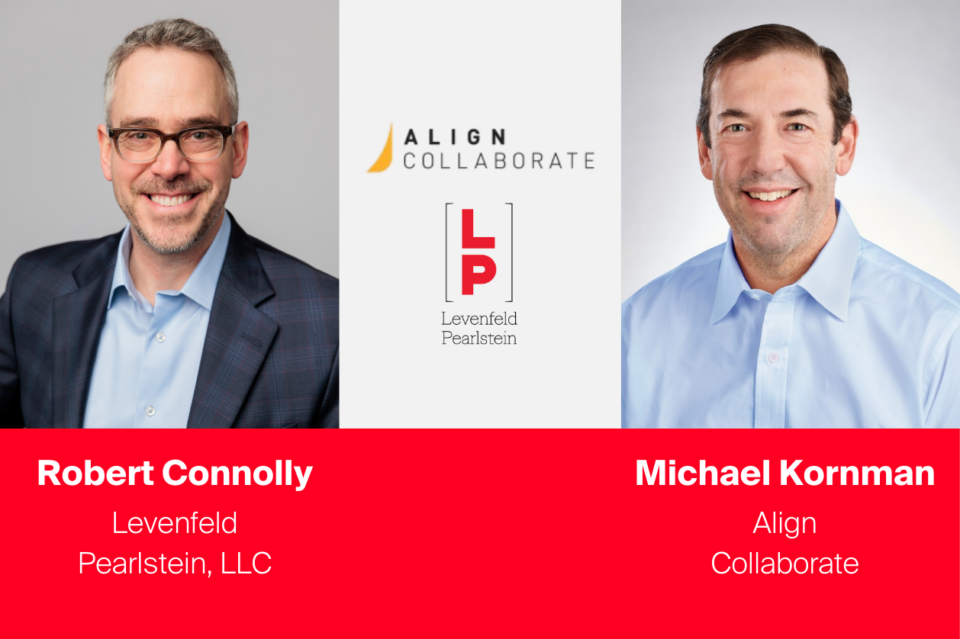
To help businesses, investors, and deal professionals better understand the evolving independent sponsor landscape, Robert Connolly—a partner in LP’s Corporate Practice Group and leader of LP’s Independent Sponsor team—shares a series of conversations with independent sponsors, capital providers, and other professionals.
Below is his conversation with Michael Kornman, a founding partner at Align Collaborate, an equity investment fund dedicated to supporting independent sponsors. Michael previously co-founded NCK Capital, a boutique independent sponsor firm, with his brother, Grant Kornman. As pioneers in the independent sponsor community, NCK Capital won numerous awards and built a successful portfolio of companies across various industries. Michael and Grant bring their experience as independent sponsors to their current roles with Align Collaborate, including serving as members of the firm’s Investment Committee. Among other topics, Michael shares Align Collaborate’s investment strategy, discusses what they look for in an independent sponsor partner, and offers advice to new independent sponsors.
The responses below have been edited slightly for brevity and clarity.
Can you tell us about Align Collaborate’s background and investment approach?
We started Align Collaborate to be an exclusive equity capital provider to independent sponsors because we saw a void in the market. Some folks are exclusively focused on investing equity, but it’s a small group, and we saw a real opportunity to offer capital based on our experiences as former independent sponsors. We’re one of the few capital providers that are former independent sponsors, and we built Align Collaborate from that native perspective.
Our approach is based on three things. First, being great partners. That’s critical. These are long marriages, and you want to be under the tent with someone who has a nice bedside manner and can be supportive. That means knowing when to stay out of the sponsor’s way and being a good partner when things are going fine, and being a great partner when things are rocky or volatile.
Second, we fundamentally believe independent sponsors are the most important people in the transactions, and we want to make sure that they are rewarded for that. There’s no reason to offer economics that are below market.
And third, we let independent sponsors take the lead on when and how to use our available resources. We work with sponsors of all types, and we have a full suite of resources from the broader Align network if that’s appropriate, but we are very sensitive to only offering those resources on a pull model by the sponsor. We understand that many sophisticated sponsors have their own playbooks, so we don’t want to step on any toes.
How has your background as an independent sponsor informed your approach?
We really believe that independent sponsors are sourcing very interesting deals at great valuations. They’re adding significant value and creating success through focused, smaller portfolios. We understand that it’s very hard to simultaneously juggle capital-raising and closing a deal. Our process is designed to be less labor-intensive for sponsors, and we want to be additive without being obtrusive. We want to make sure we can play along.
One of the things we do very well is move quickly. Another important factor for independent sponsors is the streamlined access to capital for add-on acquisitions. Sponsors that are programmatically doing add-on acquisitions want to make sure they don’t have a capital provider or partner that is low-speed and high-drag. We are focused on providing follow-on capital in a streamlined, expeditious manner.
Is there anything else you’d like to share about Align Collaborate?
We’re exclusively focused on independent sponsors. We are a team of six, and each of us lives, eats, breathes, and sleeps the independent sponsor market. Whether it’s a dedicated independent sponsor or an emerging manager who hopes to raise a fund, providing capital to independent sponsors is all we do. It’s not a tangential strategy. We don’t treat independent sponsors as a sourcing channel; they are our exclusive focus.
We’ve been fortunate to have a great reception in the market. We’re non-control investors so we aren’t trying to be a co-sponsor and that’s critically important. Many independent sponsors are rugged individualists. They want to chart their own course, and doing that requires the right partner.
What is your investment strategy? Are there certain kinds of opportunities that are a good fit given your criteria?
Generally, we’re looking for at least $3 million in EBITDA, up to about $15 million. We are lower middle market investors and we are writing $10-30 million checks. I believe we are very good at supporting buy-and-builds, where folks are starting small and need follow-on capital for add-ons. We’re attracted to B2B products and services, but it’s a broad mandate, and we have flexibility around other types of businesses.
There are two ways we approach investments. We’re looking for companies that can grow and platforms that can be built, through organic growth and add-on acquisitions. We have few hard-and-fast rules, but we gravitate towards opportunities where someone wants to make add-on acquisitions.
We are also looking at how the sponsor fits with the company. They don’t need specific industry expertise or a track record in that industry or business model, but we want them to have some angle that makes the opportunity a good fit for them.
Can you tell us about a recent investment as a case study?
We invested in a virtual manufacturer and distributor of broadband products to tier two and tier three broadband providers, with an independent sponsor comprised of two incredibly skilled gentlemen: one an industry insider and the other with a great track record as an operating partner, investor, and independent sponsor. They had formed a proprietary relationship with the founder of a business that was growing tremendously and needed some liquidity for his investors. The sponsor built the relationship and shook hands with that founder, and then they came to us for help, buying out some of the more passive minority investors to continue growing the business.
There was a change of control transaction, and we’re very excited about that sponsor and the management team, who are incredibly well-suited to make the business a large platform. They’re executing on both the organic and M&A plans. The business has secular tailwinds with the broadband and data center trends in the United States. The sponsor also had a pipeline of add-on acquisitions, which created helpful touchpoints, plus they were able to get out of the gate very quickly with the management team and CEO focusing on organic growth. The sponsors added substantial value through their commercial relationships, and they’ve done a phenomenal job of teeing up add-on acquisitions through substantive conversations with add-on targets right out of the gate.
What qualities do you look for in a potential independent sponsor partner?
We work with sponsors of all types. We work with first-time independent sponsors and with “one-person bands,” which many groups won’t do. We also work with folks who have decades of investing experience, such as full-cycle investors coming out of funds or folks intending to raise a fund.
Fit is very important. We’re looking for folks who are building deep relationships with management teams. Sometimes in these deals, there’s a management transition where the seller is retiring, but many independent sponsors win through the relationships they’ve built, so that’s an important starting point. Additionally, having an angle or edge related to the business plans is helpful. A lot of these companies need people, processes, facilities, and technology, and we like to see a value-creation plan that is well developed.
We love partnering with folks who have been operating partners or executives in industries that align with the business, whether through a similar business model, a similar commercial strategy in a different industry, or a similar value-creation angle based on prior experience applicable to this business.
Is there anything different in how you work with a first-time independent sponsor versus a more experienced sponsor?
A first-timer may take advantage of our value-creation resources. For instance, we had a sponsor who worked with our Talent Partner to source a CEO. When I was an independent sponsor and called recruiters, I didn’t get the same service or types of candidates as my friends at funds calling the same recruiter, so we can help a sponsor punch above their weight. More experienced sponsors tend to not need or want that help quite as often. But the first deal is the most important in a person’s career, so for newer independent sponsors, we can attempt to help accelerate their success.
What is the lens through which you look at the structure, economics, and governance of a deal? How should independent sponsors think about the economics of the deal?
That’s a great question. Fundamentally, from a governance standpoint, we’re a non-control investor. We’re not trying to run the show. We’re a growing but small team of six; we don’t want or have the bandwidth to run the deal. That’s important to know when you pick a partner, and you’re trying to understand their true motivations and interests. We want somebody to be the lead and be the sponsor, and we believe our deals are structured to promote that. We want folks to accomplish their goals. We have many discussions with the sponsor about what they’re trying to accomplish up front, so we can craft our arrangements and deals to try to meet their needs. If something is not going well and a sponsor needs some assistance, we can try to provide that help, but it’s not control.
As I mentioned, when it comes to economics, we strive to be fair and understand the market for economics deeply and work hard to create great alignment through those economic structures. The sponsors are betting on results. It’s not an AUM business. We understand the market deeply, and we don’t look at the independent sponsor as a cost. That’s a unique perspective informed by our prior experience as independent sponsors. We want to create a system that incentivizes sponsors to deliver outsized results.
When you’re crafting independent sponsor economic arrangements, it’s important to consider the independent sponsor’s needs not only to support the investment but also to continue growing their independent sponsor firm. We understand they’re building a team and covering their overhead, and we factor all of that in when we work with independent sponsors.
Do you want to expand on anything regarding the speed and certainty of closing and your typical process?
We’re uniquely designed to avoid leaving a sponsor at the altar, assuming we don’t learn information that creates a serious risk to close. We have a staged investment committee process. Our term sheets are more fulsome, which sometimes requires additional explanation to sponsors because we’re discussing topics early in transactions that many capital providers don’t discuss until later, but we want to move quickly. We understand that these timelines are short. When sponsors are working under tight timelines, we believe in providing high-quality service. That’s what it’s about: a service orientation. We can close deals on a short timeline and move very quickly because we understand how important that is to sponsors.
Do you prefer getting involved pre-LOI or post-LOI? Or does it depend on the circumstances?
Sponsors don’t need a fully-baked LOI to come to us. Many sponsors are under the misconception that they need everything perfectly packaged with a bow on top. However, we understand that there is a dual track of raising capital and closing a deal.
We like to get in around LOI, so we tell sponsors to call us when they have substantial traction towards an LOI, and it’s imminent. Given our bandwidth, it’s harder for us to get involved very early in the process, but if a sponsor is close to exclusivity and believes they have an imminent deal, we can jump in.
What do you think is driving the independent sponsor model’s significant growth, especially over the past 5-10 years? Why is the model gaining traction, and what’s your outlook for the segment overall?
There is a lot of new interest in the independent sponsor ecosystem and model. Though nascent, it’s a serious asset class. There are several high-quality conferences, such as Opus, ISF, and iGlobal, that provide a venue for independent sponsors to meet with capital providers and others in the ecosystem. Those events have made a tremendous contribution to developing the model.
When we started, independent sponsors were second-class citizens, but today you see folks spinning out of firms choosing this model because they’re focused on building businesses and want to exercise their entrepreneurial spirit with an investment skill set. Independent sponsors are credible buyers of businesses and have been for a long time. When you talk to investment bankers, brokers, and other intermediaries, independent sponsors are no longer looked down on as they used to be. They know that there’s a robust ecosystem of capital for independent sponsors and the certainty of close is very high.
To build on that, value creation in the lower middle market is increasingly driven by operational improvements rather than financial engineering. A good independent sponsor can bring in an investment team and an operational team, and the flexibility and bespoke nature of the deal team align well with the types of companies they’re pursuing. What are your thoughts on that?
Yes, there’s so much low-hanging fruit in the lower middle market. There are many operational enhancements that can professionalize these assets and make them attractive to upmarket private equity buyers. Several independent sponsors are pursuing specific themes or theses. We’re seeing more independent sponsors focused on certain business models or a thesis. There is a level of sophistication that is different than before.
Many opportunities require the deep dive and intense focus that independent sponsors can provide. There are complexities that independent sponsors can be uniquely suited to unwind and improve. That’s where it becomes apparent how different independent sponsor opportunities are from those a typical fund sees. It’s amazing how many opportunities are uniquely suited for great independent sponsors to capitalize on.
Looking forward over the next few years, what trends do you see in the segment, and where do you see things going?
Many things are changing in the marketplace. I see more partnerships among independent sponsors, with independent sponsors teaming up with other independent sponsors. I also see more thesis-driven work, where someone sees a deal that a fund is doing and finds an adjacency with sufficient fragmentation for a buy-and-build. I’ve seen more independent sponsors doing buy-and-builds than a single-asset, organic-growth focus. We’re seeing independent sponsors successfully closing larger deals. Independent sponsors are becoming more sophisticated in their selection of capital providers and partners to ensure they fit the opportunity, whereas previously there was less underwriting of the capital providers and their value-add.
Are there any misconceptions about the independent sponsor model or about capital providers that you want to clear up?
Some people confuse the independent sponsor model with the search fund model. They’re two different models, with differences in the types of deals and sponsors. Independent sponsors are sophisticated investors who are finding high-quality deals with significant potential to produce high returns, and we’re focused on adding value to independent sponsors. Oftentimes, if a deal is not the right deal for us, we try to connect them with others. We don’t believe relationships are proprietary, and we want to make sure that everybody’s successful. We appreciated help from our capital providers and others in the ecosystem when we were independent sponsors, and we want to pay it forward.
What advice would you give to a new independent sponsor entering the market?
It’s a partnership business, and it’s a business of collaboration. Never be afraid to pick up the phone and call a friend for information, or to reach out to people you don’t know. We look forward to continued growth at Align Collaborate. Grant and I are excited to be in this seat and help independent sponsors in the most important deals of their lives.
For more information on Michael Kornman, visit his bio. For more information on Align Collaborate, visit their website.
To read other articles in this series, please see here: Insights | LP (lplegal.com)
Interested in participating in a future interview series? Please contact Robert Connolly.