Independent Sponsor Series: Chris Larson and Matt London of Monroe Capital Discuss the Firm’s Investment Approach and Differentiation in the Independent Sponsor Market
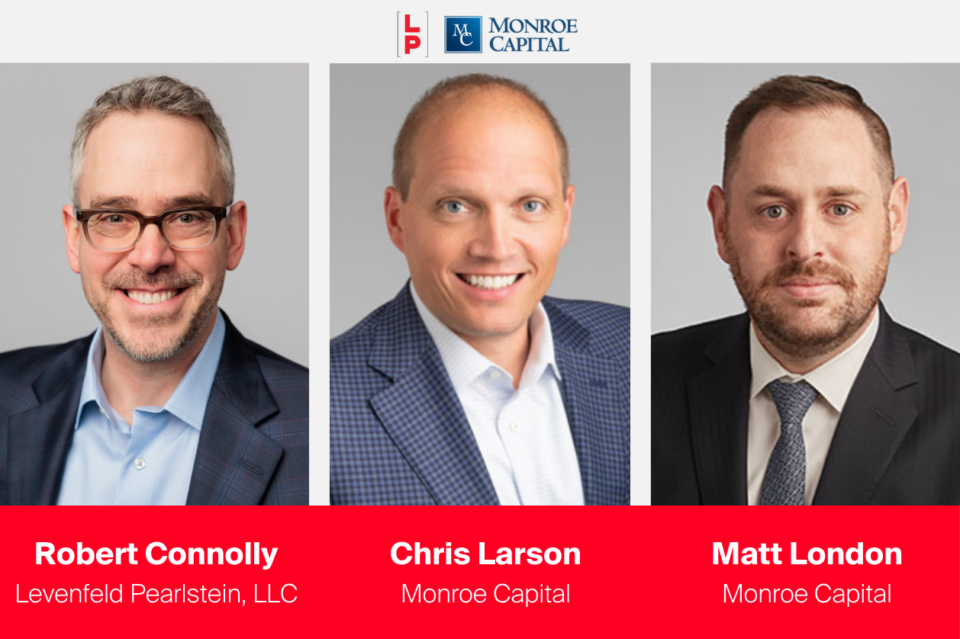
To help businesses, investors, and deal professionals better understand the evolving independent sponsor landscape, Robert Connolly – a partner in LP’s Corporate Practice Group and leader of LP’s Independent Sponsor team – shares a series of conversations with independent sponsors, capital providers, and other professionals. Below is his conversation with Chris Larson and Matt London, who are Managing Directors and Co-Heads of the Equity Group at Monroe Capital, an asset management firm that provides aligned, strategic capital solutions across industries and sectors, including to independent sponsors. Both Matt and Chris have over 20 years of experience in private equity investing.
In this interview, they share Monroe Capital’s background and investment approach, offer advice for independent sponsors, and discuss their role in independent sponsor transactions.
The responses below have been edited slightly for brevity and clarity.
Can you provide an overview of Monroe Capital and its investment approach?
Matt London: Monroe Capital is an asset management platform focused on delivering customized financing solutions across the lower middle market. With over $23.6 billion in assets under management, we are one of the largest investors in this segment. Over the firm’s history, we’ve completed more than 2,300 transactions and deployed over $55 billion in capital, always with a focus on alignment and execution.
Can you talk about the role independent sponsors play in your strategy?
Matt London: We provide independent sponsors with debt and equity capital to complete acquisitions of family- and founder-owned businesses. This is not a new strategy for Monroe — the firm has been partnering with independent sponsors since it was founded in 2004. In 2017, we invested in a dedicated team, which has grown to nine investment professionals today. That team collaborates with over 1,800 independent sponsors, evaluating more than 600 actionable deals each year.
How does your approach differ from other capital providers participating in independent sponsor transactions?
Matt London: We’re more than a lender or an equity investor — we’re an aligned, strategic partner. Our approach differs from other capital providers in three primary ways. First, providing senior debt and a material amount of equity in a single, integrated structure streamlines execution and simplifies a sponsor’s capital raise. Second, our ability to deploy between $15 million and $250 million ensures our independent sponsor partners that they will have the capital required to fund the future growth of the business, eliminating the need to raise capital across multiple rounds. Finally, our team brings the resources and network of a $20+ billion asset manager to bear on every investment.
What are your criteria for deal selection, ideal EBITDA range, and transaction size?
Chris Larson: We target buyouts of family- or founder-owned companies, typically with $3–15 million in EBITDA and transaction sizes under $200 million. At that scale, deals tend to be less competitive with more room for operational transformation. When execution goes well, multiple expansion at exit is a natural byproduct.
Can you provide more detail about the capital solutions that you offer to independent sponsors?
Chris Larson: As Matt mentioned, our core product is a combination of senior debt and equity. We prefer to be both the senior lender and the largest new equity investor in a deal, but we are also comfortable providing the debt alongside a smaller equity stake — around 20–30%. In certain situations, we start as equity only and layer in debt later as the business matures.
Check sizes range from $15 million to $200 million across debt and equity. We’re one of the few platforms that can operate across that entire range, which is particularly valuable for sponsors pursuing buy-and-build strategies.
Can you give an example of a situation where you may start as equity and then provide debt later?
Chris Larson: These generally start as roll-up transactions, where we begin with a smaller platform. In these deals, putting on $10 million of leverage might not make sense, so we may start with $15–20 million of equity and then, as we complete add-on acquisitions, bring debt into the capital structure to finance future growth.
What processes enable you to move quickly on deals?
Chris Larson: We built a dedicated team focused on making this process smooth and efficient. Because our integrated structure eliminates the need to syndicate or coordinate multiple capital sources, sponsors save time and reduce execution risk. We also leverage the broader Monroe platform and our information advantage to move quickly. We always say the second-best answer you’ll get from us is a quick “no,” and sponsors appreciate that.
When you’re looking at deals, how do you assess whether it’s a fit for Monroe Capital, and what are some of your non-negotiables?
Chris Larson: We underwrite both the sponsor and the deal. From a sponsor perspective, we look for a good cultural fit and a track record of driving value in similar situations. A non-negotiable would be if, for example, an independent sponsor has never done a healthcare deal and now has found one but lacks any relevant experience in the space. That would be hard for us.
On the deal side, we focus on the ability to professionalize and grow the business. We tend to acquire at attractive entry points in a structure where the seller is aligned through meaningful rollover. We underwrite to a conservative case that supports organic and inorganic growth. Beyond that, non-negotiables often come down to industry — for instance, we avoid cyclical sectors such as oil and gas.
What’s an ideal independent sponsor from Monroe Capital’s perspective?
Matt London: Picking the right deals is table stakes. Our core competency is matching the right partner to the right opportunity. Has this person done six roll-ups in a prior role? Do they know the industry cold with two successful exits behind them? Do they have an operating partner who used to run the largest competitor of the target? We look for sponsors with repeatable strategies and relevant operating experience — those who possess an edge beyond just being solid investors.
There’s significant growth in the independent sponsor sector. Do you work with both first-time and experienced independent sponsors? If so, how does your approach differ, if at all, between the two?
Matt London: Yes, we work with both. With first-time sponsors, we spend considerable time upfront evaluating their background and investment thesis. That matters not just because we need to believe the thesis, but because it reveals how they think about building value and executing on a plan.
In both cases — whether it’s a first-time sponsor or someone who has been doing this for 10 years and has 10 exits — we’re looking for alignment, transparency, and a clear strategy. That’s the key.
How involved is Monroe Capital during the deal process?
Matt London: We are collaborative from the day the LOI is signed through exit. Pre-close, we are active throughout diligence, helping shape the capital structure and key workstreams. Before closing, it’s critical for us to have full alignment with the sponsor on the 100-day plan and the strategic roadmap that will guide the investment.
Can you talk a bit about the current environment of the independent sponsor market?
Chris Larson: Our view is that the market is incredibly active. We’re seeing sponsors win deals over traditional lower-middle-market funds, and capital providers are increasingly there to support them. We’re also seeing more institutional interest from family offices and traditional LPs backing independent sponsors on a deal-by-deal basis. Independent sponsors have evolved into a professionalized and institutionalized segment of the market, now representing up to $30 billion in annual deal volume.
From a competitive standpoint, very few firms have a purpose-built product like ours. We have a first-mover advantage and deep relationships. Our sponsor partners tend to come back to us time and again, and we believe this gives us a meaningful edge in an increasingly crowded environment. To date, we’ve deployed more than $1 billion alongside independent sponsors, demonstrating long-term commitment and staying power.
How do you think about economics and governance terms with independent sponsors?
Matt London: We structure governance for support, not control. This includes board seats, consent rights over key corporate decisions, and downside protection. On economics, we design packages that reward sponsors for performance — we favor partners who want to bet on themselves, and our structures reflect that.
How do you think about promote structures, and how should sponsors think about them when they’re approaching a capital provider?
Matt London: Our promotes are designed to reward sponsors for delivering at or above their projected base case returns. The packages offer considerably more upside than a traditional funded sponsor would receive, tied directly to outsized equity returns. We anchor on the base case the sponsor presents, with a clear view of the upside scenario, and incentivize performance within that range. It varies deal by deal.
How do you evaluate multiples and value creation opportunities, especially in a competitive auction process?
Chris Larson: We think a lot about that. Small buyouts offer distinct advantages: lower entry multiples, less competition, and ample room for transformation. If you do your job, professionalize the business, and grow it, you can achieve significant multiple expansion. However, if you overpay on the front end, it makes things more difficult and, frankly, riskier from a capital standpoint. So yes, we are very focused on the entry point. We do not need below-market pricing on every deal, but it does not hurt.
For sponsors approaching Monroe or another capital provider, what advice would you give them?
Chris Larson: I think the biggest piece of advice we give sponsors is to think about your capital structure not only at close but throughout the life of the deal. Independent sponsors sometimes become so focused on getting the deal closed that they do not consider whether their capital provider will have enough capital to support them through the entire journey — from growth to exit. We get a lot of calls from sponsors looking to recapitalize their capital provider, which brings a host of challenges around valuation and where the carry stands. We have historically had a difficult time with those situations, so we advise independent sponsors to select the capital partner that can get you to exit, not just the first quarter.
At the recent iGlobal Forum, some panelists discussed how smaller companies are building their own platforms and succeeding with that model. What are your thoughts on that approach?
Matt London: It is a tried-and-true model within private equity. The key risk, as Chris noted, is optimizing solely for who can get the first deal done. In a roll-up, you may invest heavily in building a platform — infrastructure, management, systems — only to discover your capital partner cannot fund the subsequent acquisitions. For roll-ups in particular, sponsors need to evaluate not just the closing, but whether their partner can support the full build-out over two to four years.
How do you expect the independent sponsor model to evolve over the next three or five years?
Matt London: We expect continued growth and further institutionalization. More sponsors will build repeat platforms, and capital providers will continue to adapt to better serve them. The model will become even more mainstream, but the best sponsors will still be those who stay close to the ground, focus on execution, and recognize that the lower middle market rewards hard work and persistence. The sponsors who are hungry and willing to put in that effort are going to excel in this market today, in five years, and in 10–15 years.
For more information, visit Chris Larson’s bio, Matt London’s bio, or Monroe Capital’s website.
To read other articles in this series, please visit: Insights | LP (lplegal.com)
Interested in participating in a future interview series? Please contact Robert Connolly.